Facial recognition technology: technical concepts and mark scheme tips
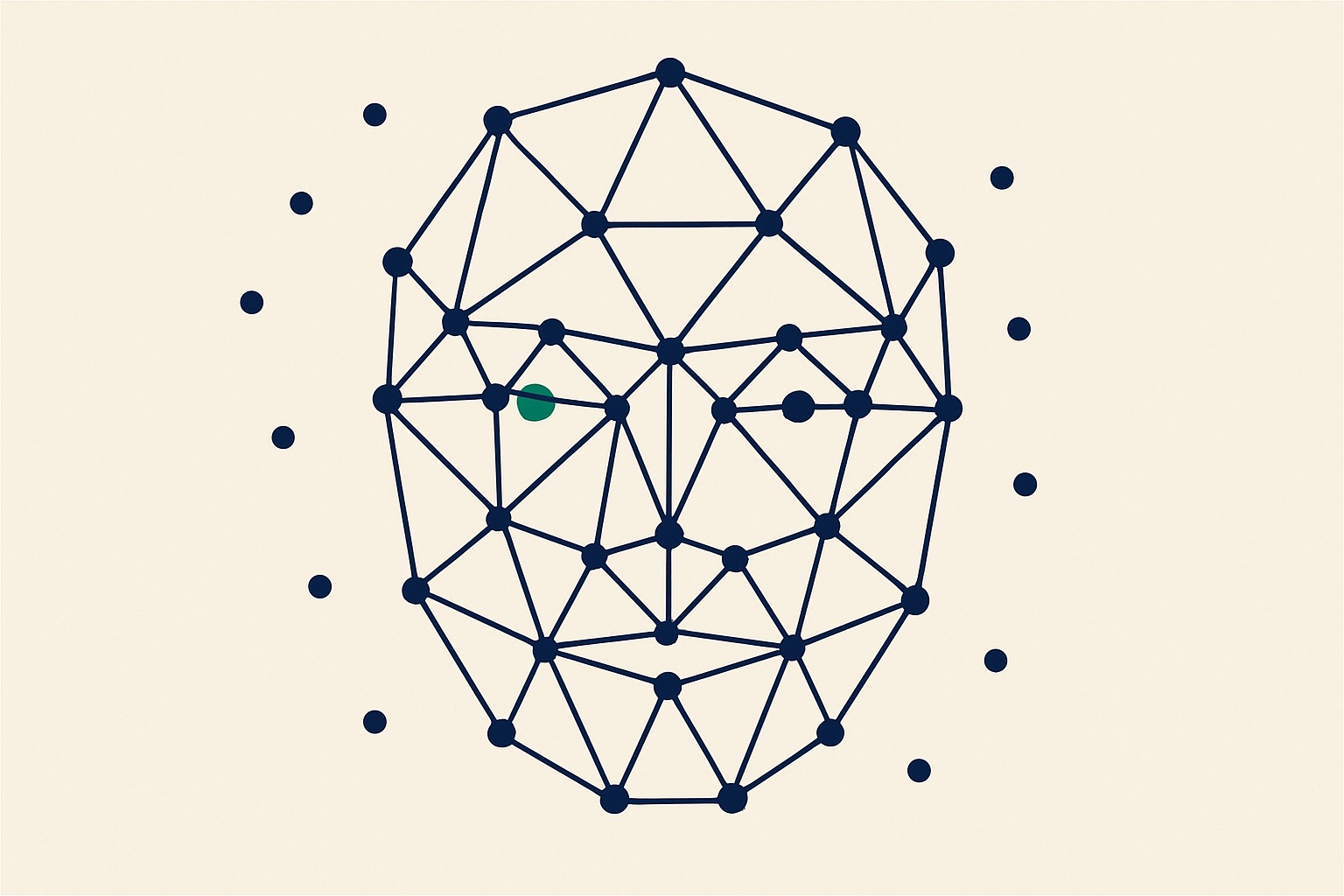
Facial recognition technology is a computer vision process that identifies or verifies a person from a digital image or video frame. It works by detecting a human face in an image, extracting specific mathematical features to create a high-dimensional facial embedding, and comparing this numerical representation against a database of known faces. The system then calculates the distance between these embeddings to determine if there is a match.
When you sit down to write your computer vision exam, examiners want to see that you understand this pipeline as a sequence of distinct mathematical steps. Many students lose marks by confusing detection with recognition, or by failing to explain how convolutional neural networks transform pixel data into a comparable mathematical vector. As a practitioner, I see these exact fundamentals applied in commercial systems ranging from mobile phone authentication to automated border control checkpoints. Mastering the specific vocabulary and algorithms at each stage will turn a vague descriptive answer into a high-scoring technical response.
Face detection versus facial recognition
The most common mistake students make in exams is treating face detection and facial recognition as the same process. Face detection is strictly a binary classification problem where the system asks if a face is present in a given region of an image. Older systems achieved this using Viola-Jones and Haar cascades, which scanned images for contrasting light and dark regions typical of human faces. Modern pipelines typically use multi-task cascaded convolutional networks to draw an accurate bounding box around any face in the frame.
Once the face is detected and cropped, the pipeline moves to alignment. If a person is looking slightly to the side or tilting their head, comparing their raw pixels directly to a straight-on passport photo will fail. Alignment algorithms locate key facial landmarks, such as the corners of the eyes and the tip of the nose. The image is then geometrically transformed (rotated, scaled, and translated) so these landmarks sit in standard coordinates. This standardisation is crucial because neural networks are highly sensitive to spatial variations.
Only after detection and alignment does the system perform facial recognition. Recognition is the process of mapping the aligned face to a specific identity. In an exam, you should clearly separate these three stages: detection, alignment, and recognition. If a question asks you to design a biometric system for a building entrance, your architecture diagram must show the input video frame passing through a bounding box generator and an alignment phase before any identity verification takes place.
Feature extraction and facial embeddings
The core of modern facial recognition relies on deep learning architectures to extract features. Instead of engineers manually defining what makes a face unique, we train a convolutional neural network to learn the optimal filters. When an aligned face image passes through the convolutional layers, the network outputs a high-dimensional vector known as a facial embedding. You will often see this referred to as a 128-dimensional or 512-dimensional representation. Think of this embedding as a unique numerical fingerprint for that specific face.
To train this network, practitioners frequently use a loss function called triplet loss. Triplet loss requires three images during training: an anchor image of a specific person, a positive image of that same person, and a negative image of a different person. The network calculates the embeddings for all three. The loss function then penalises the model if the distance between the anchor and the positive embedding is greater than the distance between the anchor and the negative embedding plus a set margin. Over millions of training iterations, the network learns to cluster embeddings of the same identity closely together while pushing different identities far apart in the vector space.
Let us look at a simplified worked example. Imagine a highly simplified two-dimensional embedding space. The network processes an image of Alice and produces the vector (0.8, 0.2). It processes a second image of Alice with different lighting and outputs (0.75, 0.25). Finally, it processes an image of Bob and outputs (0.1, 0.9). Plotting these points on a graph shows the two Alice embeddings sitting close together, while Bob is located far away. In a real system, this mathematical clustering happens across 128 or more dimensions, allowing the network to encode incredibly subtle differences in facial geometry.
Distance metrics and identity classification
Generating an embedding is only half the battle. To verify an identity, the system must compare the newly generated vector against stored vectors in a database. Exam questions frequently ask you to explain how a system decides if two images show the same person. The answer lies in distance metrics. The two most common mathematical approaches to measure the similarity between high-dimensional vectors are Euclidean distance and cosine similarity.
Euclidean distance calculates the straight-line distance between two points in the embedding space. If the distance is very small, the faces are highly likely to belong to the same person. Cosine similarity measures the cosine of the angle between two vectors projecting from the origin. If two vectors point in the exact same direction, their cosine similarity is 1. If they are orthogonal, it is 0. Cosine similarity is particularly popular in facial recognition because it focuses on the orientation of the features rather than their magnitude, making it less sensitive to variations in lighting or contrast.
To make a final decision, the system relies on a predefined threshold. If the distance between the new embedding and the stored database embedding falls below this threshold, the system declares a match. Setting this threshold is a balancing act between false acceptances and false rejections. A low threshold (requiring vectors to be almost identical) increases security but will reject legitimate users if they wear glasses or change their hairstyle. A high threshold is more forgiving but might allow an imposter to access the system. Examiners love to test your understanding of this mathematical trade-off.
Environmental challenges and demographic bias
A purely mathematical explanation will get you most of the marks, but top-tier answers demonstrate an awareness of real-world constraints. Computer vision models degrade rapidly when environmental conditions change. Poor illumination, harsh shadows, and extreme camera angles alter the pixel values fed into the network. Even minor occlusions, such as a user wearing a medical mask or a heavy scarf, obscure the facial landmarks required for alignment and feature extraction. When evaluating a system architecture in an exam, always discuss how it handles these environmental variations.
Demographic bias is another critical area that frequently appears in applied machine learning exams. Historically, many facial recognition systems were trained on datasets overwhelmingly composed of lighter-skinned, male faces. As a result, the networks learned to extract features that were highly discriminative for that demographic but performed poorly on darker-skinned faces or female faces. This is a fundamental failure of generalisation. If a question asks you to critique a system, pointing out the necessity for a diverse, representative training dataset is an excellent way to show applied engineering judgement.
You can also gain marks by discussing presentation attacks, often called spoofing. A basic facial recognition system cannot tell the difference between a live human and a high-resolution photograph held up to the camera. Modern pipelines include liveness detection, which might require the user to blink, or use depth sensors and infrared cameras to confirm the three-dimensional geometry of the face. Showing that you understand the difference between algorithmic accuracy and system security will elevate your answer significantly.
How to answer this in an exam
When faced with a facial recognition question, your priority is to structure your answer sequentially. Start by explicitly naming the stages: detection, alignment, feature extraction, and matching. Mark schemes heavily reward students who use precise terminology. Do not write that the system “looks at the face”. Write that a convolutional neural network “extracts a high-dimensional feature embedding”. This signals to the examiner that you understand the underlying mathematics of the process.
If you are asked to compare different approaches, focus on the loss functions and distance metrics. Discussing triplet loss or contrastive loss shows a deeper understanding of how a network learns to separate identities. Be sure to link your technical explanation to the specific scenario provided in the question. If the scenario involves a high-security banking application, you must explicitly mention the need for a strict distance threshold to minimise false acceptances, along with liveness detection to prevent spoofing.
The Full Marks Press Computer Vision guide covers this with worked exam questions, showing you how to structure your paragraphs to hit every requirement on a university mark scheme. We break down past paper scenarios so you can see exactly where students drop marks and how to secure them. Practising with these applied scenarios is the best way to move from memorising definitions to demonstrating true engineering competence. You can download a free copy to help with your revision at fullmarkspress.com/free.
Frequently asked questions
What is the difference between face verification and face identification? Face verification is a 1-to-1 matching process where the system checks if a person is who they claim to be by comparing their face to a single stored template. Face identification is a 1-to-N matching process where the system searches a large database to find out who the person is without any prior identity claim.
Why do we use convolutional neural networks for facial recognition instead of traditional algorithms? Convolutional neural networks automatically learn the optimal features from raw pixel data. This makes them far more accurate at handling natural variations in lighting, pose, and facial expression compared to manually engineered feature extractors like Local Binary Patterns.
What does a false acceptance rate mean in this context? The false acceptance rate measures the frequency at which the system incorrectly matches a new face to a different person’s stored embedding. In secure systems, keeping this metric as close to zero as possible is a primary design goal, usually achieved by setting a strict distance threshold.
How does triplet loss improve facial embeddings? Triplet loss forces the neural network to minimise the mathematical distance between embeddings of the same person while simultaneously maximising the distance between embeddings of different people. This creates highly clustered and distinct identity representations in the vector space.