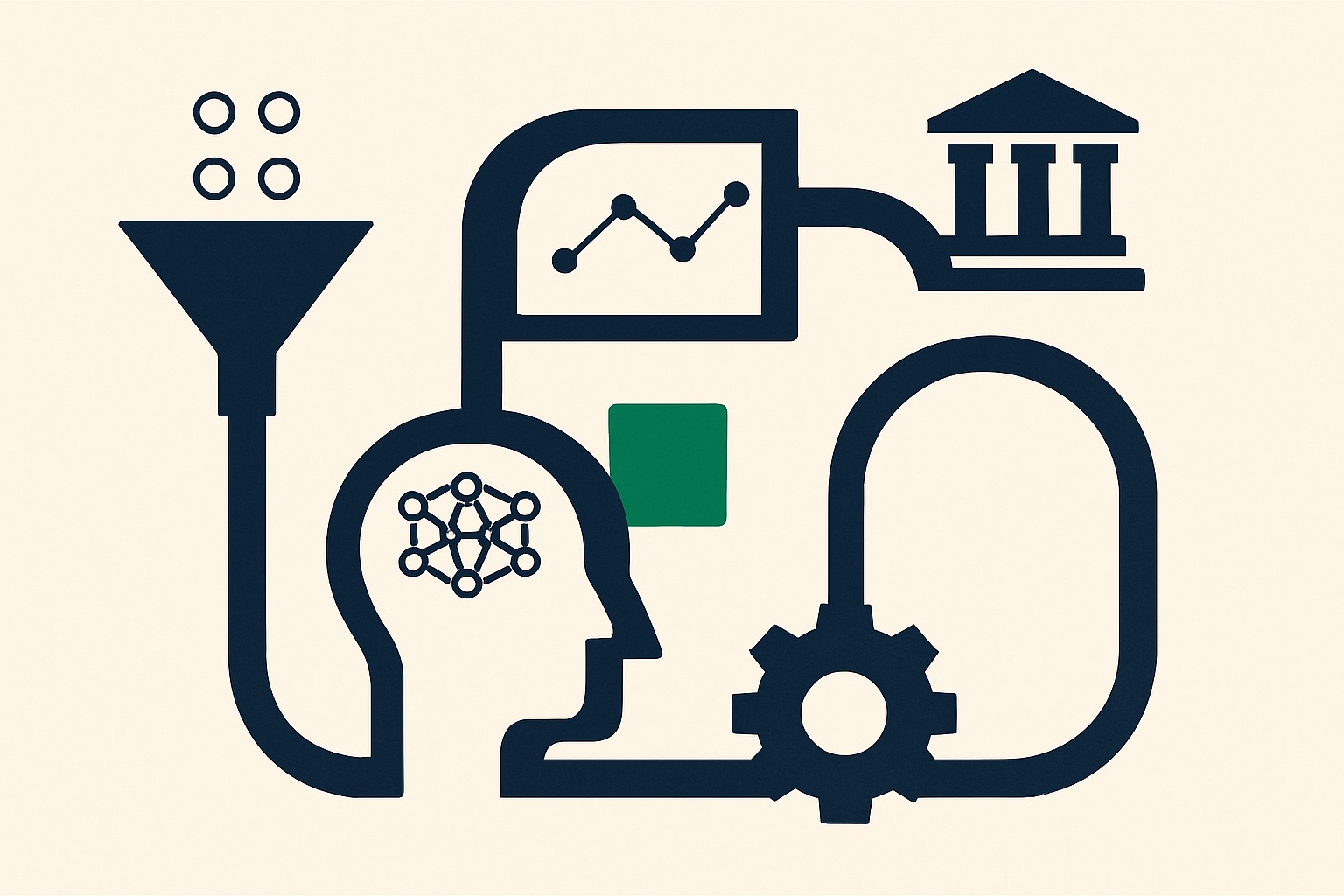
What is MLOps and why are universities teaching it now?
Machine Learning Operations (MLOps) is a set of engineering practices that unifies machine learning system development with software operations to ensure models can be deployed, monitored, and maintained reliably in production environments. Universities are teaching it now because industry demand has shifted from creating isolated, highly accurate models in research settings to building automated pipelines that handle continuous data updates and prevent model degradation in the real world.
When students begin studying artificial intelligence, they often assume that algorithmic design is the final goal of the discipline. You might spend weeks perfecting a neural network architecture, only to discover that the code required to train and evaluate that model makes up a tiny fraction of a real-world commercial system. The vast majority of the infrastructure is dedicated to ingesting data, serving predictions, and monitoring the model’s ongoing health. MLOps provides the framework to manage this complex infrastructure, moving machine learning out of the laboratory and into sustainable, continuous operation.
The transition from isolated notebooks to production systems
When you first start studying machine learning, your practical exercises almost certainly take place inside a Jupyter notebook. You download a static dataset, clean the missing values, train a classifier, and calculate your final accuracy score. Once the model outputs a high validation score, the project is considered finished. This workflow is excellent for grasping the underlying mathematics of gradient descent or understanding how different hyperparameters affect a decision tree. However, it represents an isolated, simplified version of artificial intelligence development.
In a commercial environment, a machine learning model is never a static artefact. It is a living component of a larger software ecosystem. A production model might need to serve predictions to thousands of concurrent users, respond in milliseconds, and consume data that changes format unexpectedly. The surrounding infrastructure required to serve, monitor, and continuously update that model is vast. If a company relies on manual notebook execution to update its live systems, it will inevitably face downtime, errors, and significant financial losses.
This stark difference between academic exercises and commercial reality is where MLOps enters the picture. It takes the established principles of software DevOps (Continuous Integration and Continuous Deployment) and adapts them for the unique challenges of artificial intelligence. While traditional software engineering focuses primarily on versioning code, MLOps requires engineering teams to version code, data, and model parameters simultaneously. If you cannot reproduce the exact state of a system from three months ago, you cannot safely diagnose a production failure or audit a biased algorithmic decision.
Core components of an automated MLOps pipeline
To answer exam questions on this topic effectively, you need to understand the distinct stages of an automated machine learning pipeline. The first major component is data ingestion and versioning. Just as software engineers use Git to track changes to their source code, machine learning engineers use specialised tools to track changes to their datasets. If a model suddenly starts making poor predictions, the engineering team must be able to roll back to the exact training dataset used the previous week to identify what went wrong.
The next component is continuous training and validation. Let us look at a short worked example. Suppose you are building a fraud detection system for a commercial UK bank. Financial criminals constantly change their tactics, meaning the transaction data your model sees in January will look very different by June. An MLOps pipeline handles this by monitoring the incoming live transactions. When it detects that the statistical properties of the transactions have changed, the pipeline automatically triggers a new training job. It pulls the latest transaction data, retrains the fraud detection model, evaluates the new model against a holdout dataset, and flags it for deployment if the accuracy exceeds the current baseline.
Once the new model passes its automated validation checks, it enters the model registry. A model registry acts as a strict central repository that tracks every trained model, its hyperparameters, its evaluation metrics, and its deployment status. When the operations team needs to deploy the new fraud detection model, they pull it directly from this registry. They might deploy it using a canary release strategy, where the new model processes only five per cent of the live traffic initially. This limits the potential damage if the new model unexpectedly performs poorly in the live environment.
Finally, the pipeline requires constant monitoring and observability. Traditional software monitoring tracks metrics like CPU usage and memory consumption. Machine learning monitoring tracks those exact same hardware metrics, but it must also track the statistical behaviour of the predictions. If the model starts rejecting an unusually high number of legitimate bank transactions, the monitoring system must alert the engineering team immediately so they can intervene.
The challenge of hidden technical debt and drift
Examiners frequently test your understanding of why machine learning systems are uniquely difficult to maintain compared to traditional software systems. Traditional software follows deterministic logic. If you write a function to calculate sales tax, that function will continue to calculate sales tax correctly until the underlying code is modified or the hardware fails. Machine learning systems are fundamentally different because their operational behaviour is dictated by the external data they consume.
This creates a dangerous situation where a machine learning system can fail silently. The application might still be running perfectly from a software perspective. The servers are online, the application programming interface is returning responses quickly, and no error codes are appearing in the logs. However, the predictions the model is making might be completely wrong. This degradation happens because the real world is constantly changing, a phenomenon known as drift.
Data drift occurs when the distribution of the input features changes over time. Imagine a computer vision model trained to inspect manufactured parts on a factory assembly line. If the lighting in the factory slowly dims over several months, the pixel values of the images fed into the model will change. The model will start misclassifying parts, even though the code has not changed at all. Concept drift occurs when the fundamental relationship between the input features and the target variable changes. A classic example is a retail forecasting model trained on historical shopping data. When consumer purchasing habits changed drastically during recent global supply chain disruptions, the underlying patterns the models had learned were suddenly obsolete.
Without MLOps practices, these silent failures compound into massive technical debt. Engineering teams find themselves relying on fragile, undocumented scripts to manually retrain models every time the data shifts. They create tangled architectures where data extraction, preparation, and training steps are mixed together. By implementing strict MLOps frameworks, organisations separate these concerns and create repeatable, automated workflows that catch silent degradation before it impacts the end user.
Why university curricula have evolved
Historically, computer science and data science degree programmes treated machine learning primarily as a branch of applied mathematics. Modules focused heavily on algorithmic theory, calculus, linear algebra, and statistical proofs. Students spent their time deriving the backpropagation algorithm by hand or proving the mathematical convergence properties of support vector machines. This theoretical foundation remains essential for understanding how artificial intelligence works at a fundamental level.
However, as the commercial industry matured, employers began reporting a significant skills gap. Graduates were entering the workplace with an excellent grasp of theoretical mathematics but limited understanding of how to package a model into a container, expose it via a web service, or set up an automated retraining loop. They could build a model that achieved high accuracy on a clean, static dataset, but they struggled to integrate that model into a larger software architecture.
Accreditation bodies and industry advisory boards responded by pushing universities to update their syllabuses. The academic focus has shifted from purely creating models to engineering complete intelligent systems. Universities are now teaching MLOps to ensure their graduates possess the software engineering discipline required to deploy machine learning safely. Our Full Marks Press MLOps guide covers this exact shift with worked exam questions, showing you how to structure answers that bridge theoretical machine learning and practical engineering.
You will notice this shift in your exam papers. You are no longer just asked to compare the accuracy of two different classification algorithms. Instead, you are frequently presented with a scenario where a company has deployed a model that is now failing, and you must design an architectural solution to fix it. This requires a systems-thinking approach, blending data science knowledge with software operations.
How to answer this in an exam
When you face an MLOps scenario in a university exam, the mark scheme will reward students who demonstrate a clear understanding of the entire machine learning lifecycle. Do not fall into the trap of focusing solely on the model architecture. If the question asks how to improve a failing production system, suggesting a switch from a random forest to a deep neural network is rarely the correct answer. The examiner is looking for operational and architectural solutions.
Read the scenario carefully to diagnose the specific type of failure. If the prompt describes a model that was highly accurate during testing but is slowly losing accuracy over several months in production, you must explicitly use terms like “data drift” or “concept drift”. The mark scheme will allocate points for identifying the drift correctly and allocate further points for proposing an automated retraining trigger to resolve it.
Structure your answer chronologically through the MLOps pipeline. Start with data ingestion and validation, move to automated training, discuss the model registry, and finish with deployment and monitoring strategies. Be highly specific about your deployment strategy. Mentioning A/B testing or shadow deployments shows the examiner that you understand the commercial risks associated with replacing a live model. By naming the specific operational safeguards you would put in place, you demonstrate the exact engineering judgment the examiners want to see.
Frequently asked questions
Is MLOps just DevOps for machine learning? It builds directly upon DevOps principles like continuous integration and continuous deployment, but it introduces the requirement for continuous training and data validation. Traditional software code does not degrade on its own, but machine learning models degrade organically as the external environment changes, requiring continuous operational oversight.
What is the difference between data drift and concept drift? Data drift happens when the statistical properties of your input features change over time, such as a physical sensor slowly losing calibration. Concept drift happens when the fundamental relationship between those input features and the target variable changes, such as consumers entirely changing their financial habits during an economic recession.
**Do I need to memorise specific software tools for my exam?