What is the attention mechanism in deep learning?
The attention mechanism in deep learning is a computational technique that allows a neural network to dynamically focus on the most relevant parts of an input sequence when generating an output. Instead of compressing an entire input into a single fixed-length vector, attention assigns varying mathematical weights to different input elements based on their immediate relevance to the current task. This means the model can selectively ‘attend’ to specific words in a sentence or regions in an image, directly addressing the information bottleneck found in older sequential models.
Understanding this concept is foundational for modern artificial intelligence module exams. Before attention was introduced by Bahdanau and colleagues in 2014, sequence-to-sequence models struggled significantly with long inputs. A model trying to translate a lengthy paragraph would effectively forget the beginning of the text by the time it reached the end. By allowing the network to look back across the entire input sequence at every single step of the output generation, attention fundamentally changed how machines process language and data.
Today, this mechanism is the core mathematical engine behind the Transformer architecture, which powers the large language models you interact with regularly. Examiners expect you to understand not just what attention does conceptually, but precisely how it calculates relevance using queries, keys, and values. You will need to demonstrate why this approach is computationally superior to earlier methods and how it resolves specific architectural limitations in deep learning.
The problem attention solves: the context bottleneck
To understand why attention is necessary, you must first understand the architecture it improved upon. Early sequence-to-sequence modelling relied heavily on Recurrent Neural Networks (RNNs) and Long Short-Term Memory (LSTM) networks. These operated using a strict encoder-decoder structure. The encoder processed an input sequence one step at a time, updating a hidden state at each step. Once the entire input was processed, the final hidden state was passed to the decoder to begin generating the output.
This final hidden state was known as the context vector. The network was forced to compress every single piece of information, syntax, and semantic meaning from the input sequence into this one fixed-length mathematical representation. For a three-word sentence, this works perfectly well. For a fifty-word legal document sentence, it creates a severe information bottleneck. The mathematical representation simply does not have the capacity to retain all the nuances of a long sequence, leading to a phenomenon where early sequence information is overwritten or diluted by later inputs.
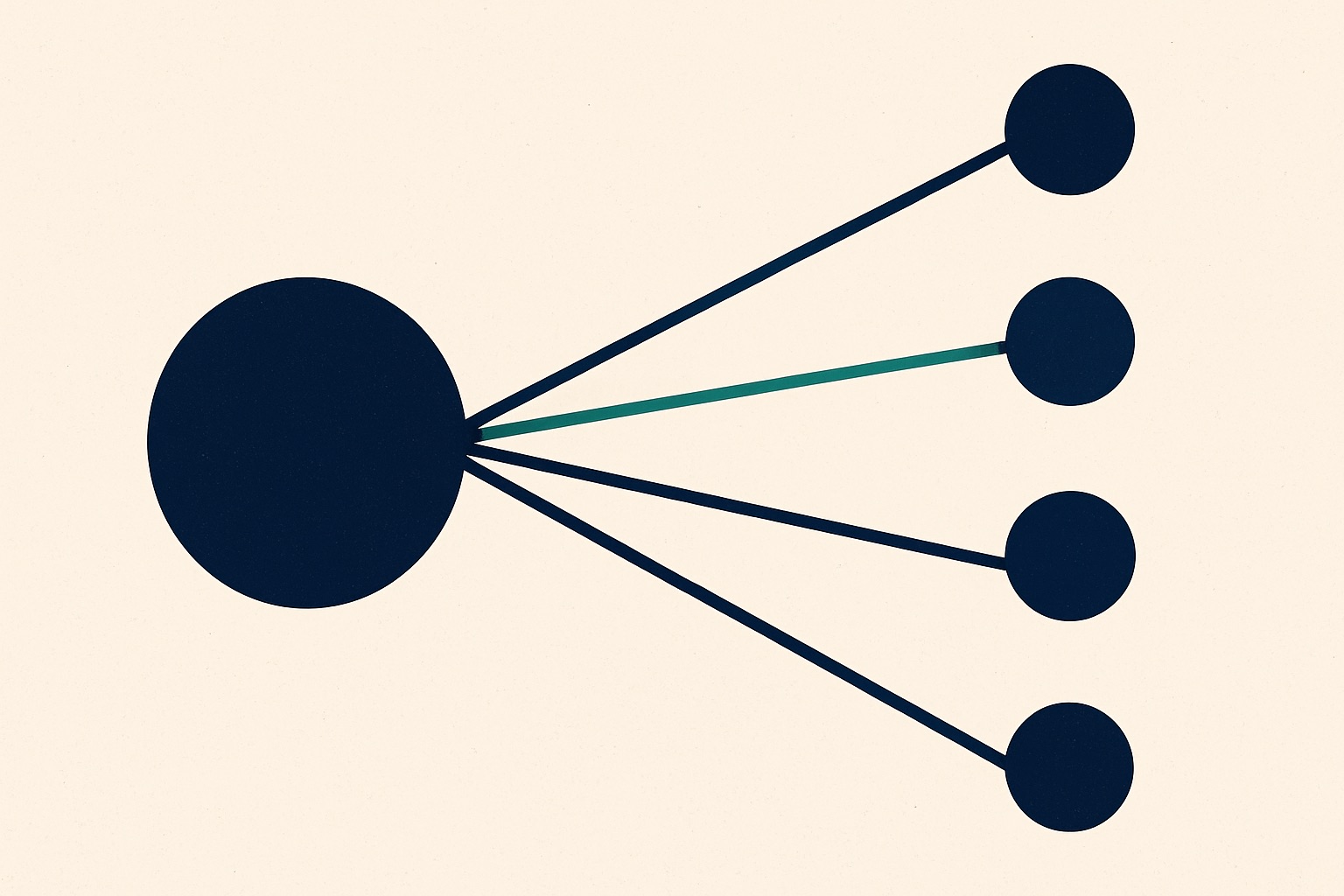
Attention completely bypasses this bottleneck. Instead of forcing the encoder to pass a single compressed vector to the decoder, the attention mechanism gives the decoder access to the hidden states of every single step from the encoder. When the decoder is about to generate a new word, it looks at the entire collection of encoder hidden states and calculates a relevance score for each one. The model then creates a custom context vector on the fly, heavily weighting the specific input words that matter for that exact moment of generation while ignoring irrelevant ones.
How attention works: Queries, Keys, and Values
The mathematical operation of attention is best understood through the framework of queries, keys, and values. This concept is directly inspired by database retrieval systems. Imagine you are in a library searching for a book on artificial intelligence. Your search term is the ‘query’. The titles on the spines of the books are the ‘keys’. The actual text inside the book you select is the ‘value’.
In an attention mechanism, the query, key, and value are all numerical vectors. The query represents the current state of the decoder, essentially asking the mathematical question, “What information do I need next?” The keys represent the hidden states of the input sequence, essentially stating, “Here is the information I contain.” The values are typically identical to the keys in basic attention setups, representing the actual content that will be extracted if the key matches the query.
To find out which keys match the query, the network calculates the dot product between the query vector and every single key vector. The dot product is a mathematical measure of similarity. If a query vector and a key vector point in similar directions in their high-dimensional space, their dot product will be a large positive number. If they are unrelated, the number will be near zero or negative. This calculation results in a raw score for every word in the input sequence, indicating how relevant each word is to the current query.
Because these raw scores can be extremely large or extremely small, they are passed through a softmax function. The softmax function normalises the scores, converting them into a probability distribution that always sums exactly to one. A highly relevant input word might receive a softmax weight of 0.85, while irrelevant words might receive weights of 0.01. Finally, the network multiplies these softmax weights by their corresponding value vectors and adds them all together. This weighted sum is the dynamic context vector that the model uses to generate its next output.
A worked example of calculating attention
Consider a machine translation model translating the French sentence “Je mange une pomme rouge” into the English sentence “I eat a red apple”. Let us look at the exact moment the model is trying to generate the English word “apple”. The decoder has already output “I eat a red” and now needs to determine the final word.
The current hidden state of the decoder (which contains the context of having just generated the word “red”) becomes the query vector. The encoder holds five key vectors, one for each of the original French words. The attention mechanism calculates the dot product between the decoder’s query vector and each of the five encoder key vectors to generate raw similarity scores.
The model evaluates the grammatical and semantic relationships it learnt during training. The dot product score for the key corresponding to “pomme” (apple) will be very high, perhaps yielding a raw score of 9.2. The key for “rouge” (red) might yield a moderate score of 3.1 because adjectives and nouns are related. The keys for “Je”, “mange”, and “une” will yield low or negative scores.
When the softmax function is applied to these raw scores, the high score for “pomme” is converted into a dominant weight, for instance, 0.90. The score for “rouge” might become 0.08, and the remaining words share the final 0.02. The mechanism then takes the value vectors of the French words, multiplies them by these exact weights, and sums them up. The resulting context vector is composed of 90 percent of the mathematical meaning of “pomme”, providing the decoder with exactly the right information to output the English word “apple”.
Self-attention and the Transformer architecture
While standard attention connects a decoder to an encoder, self-attention allows a sequence to look at itself. This is the defining innovation of the Transformer architecture. In self-attention, the queries, keys, and values all come from the exact same input sequence. The goal is not to translate from one language to another, but to build a mathematically rich representation of a sequence by understanding how every word relates to every other word in that same sequence.
Take the English word “bank”. It has entirely different meanings in the phrases “bank of the river” and “bank account”. When a self-attention mechanism processes the word “bank” in the first phrase, it creates a query for “bank” and compares it against the keys of all the surrounding words. The dot product between “bank” and “river” will produce a high attention weight. The resulting updated value vector for “bank” will blend in the mathematical meaning of “river”, allowing the network to understand that this specific instance refers to geography, not finance.
Transformers take this a step further by using multi-head attention. Instead of calculating attention once, the model computes it multiple times in parallel using different learnt projection matrices. One attention head might learn to track subject-verb agreements, while another head simultaneously tracks pronoun references. By concatenating the results of all these heads, the network builds an incredibly detailed, multi-faceted understanding of the input data, executing all of this computation in parallel rather than sequentially.
How to answer this in an exam
When an exam question asks you to explain the attention mechanism, mark schemes heavily reward mathematical precision. You should always include the formula for scaled dot-product attention: softmax(QK^T / square root of d_k) multiplied by V. Writing this formula demonstrates that you understand the exact matrix operations happening under the hood, moving your answer from a superficial description to a rigorous academic explanation.
Examiners frequently look for the specific justification of scaling. You must explain why the dot product of the query and key (QK transposed) is divided by the square root of the key dimension (d_k). The correct answer is that for large dimensions, dot products grow very large in magnitude, which pushes the softmax function into regions where gradients become extremely small. Scaling prevents these vanishing gradients and keeps the learning process stable.
A common trap students fall into is failing to distinguish between standard encoder-decoder attention and self-attention. Always read the question carefully to see which architecture is being tested. If the question involves Transformers, you must explicitly define self-attention and mention that queries, keys, and values are derived from the same input sequence. If you want to see exactly how these distinctions are graded, the Full Marks Press Deep Learning and Generative AI guide covers this with worked exam questions and detailed mark scheme breakdowns.
Frequently asked questions
What is the difference between hard and soft attention? Soft attention calculates a probability distribution over all input elements, meaning every element gets some weight (even if tiny) and the process is fully differentiable for backpropagation. Hard attention forces the model to select one specific input element to focus on entirely, which is non-differentiable and requires reinforcement learning techniques to train.
Why do we divide by the square root of the key dimension in scaled dot-product attention? As the dimensionality of the vectors increases, the dot products can result in exceptionally large values. Passing excessively large values into a softmax function pushes the outputs towards absolute one or zero, which flattens the gradients and halts the learning process. Dividing by the square root of the dimension scales the values down, keeping the gradients stable during training.
Can attention be used for computer vision as well as text? Yes. Vision Transformers (ViTs) divide an image into a grid of small patches and treat each patch exactly like a word in a sentence. The attention mechanism then calculates how every patch in the image relates to every other patch, allowing the model to understand complex spatial relationships and object boundaries without using traditional convolutional layers.
Does attention replace recurrent neural networks entirely? In most modern, large-scale applications like generative artificial intelligence, attention-based Transformers have entirely replaced Recurrent Neural Networks. Because attention processes all tokens simultaneously rather than sequentially, it allows for massive parallel computation on graphics processing units, cutting down training time while vastly improving the model’s ability to retain long-range dependencies.
You can download a free digital copy of the revision guide at fullmarkspress.com/free.