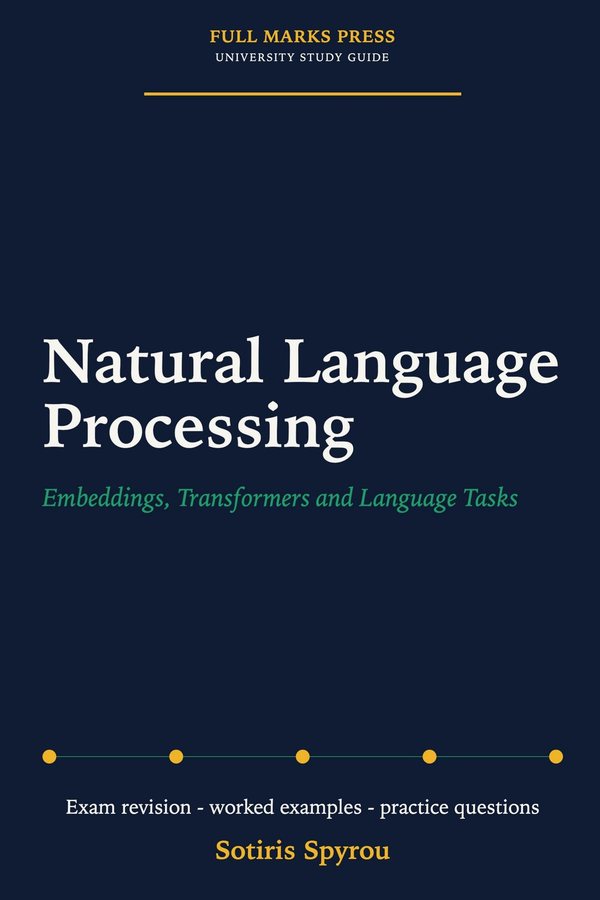
Natural Language Processing
Embeddings, Transformers and Language Tasks: A University Exam Revision Guide
Paperback $24.99 / £19.99, Kindle $9.99 / £7.99
About this guide
Natural language processing revision from TF-IDF to transformers, by hand. This natural language processing study guide covers the module in 14 chapters: what NLP is and why language is hard; text preprocessing and tokenisation; bag-of-words and TF-IDF; classical text classification; word embeddings; n-gram language models; neural language models; RNNs and LSTMs; attention and the transformer; contextual embeddings and pretrained models such as BERT, GPT and T5; NER, sentiment, translation and question answering; evaluation metrics; bias and safety; and responsible AI for language systems. 13 of its 14 chapters carry a worked example.
Every chapter has a memory hook, checkpoint questions with answers, an examiner trap, a top-marks box, a key term, a chapter summary, flashcards and a one-page mind map.
Inside the guide
- TF-IDF
- Classical text classification
- Word embeddings
- N-gram and neural language models
- Recurrent networks
- Attention and transformers
- Contextual embeddings
- With evaluation
- Bias and safety
Questions students ask
What does Natural Language Processing cover?
This natural language processing study guide covers the module in 14 chapters: what NLP is and why language is hard; text preprocessing and tokenisation; bag-of-words and TF-IDF; classical text classification; word embeddings; n-gram language models; neural language models; RNNs and LSTMs; attention and the transformer; contextual embeddings and pretrained models such as BERT, GPT and T5; NER, sentiment, translation and question answering; evaluation metrics; bias and safety; and responsible AI for language systems.
What does every chapter include?
Every chapter has a memory hook, checkpoint questions with answers, an examiner trap, a top-marks box, a key term, a chapter summary, flashcards and a one-page mind map of the chapter.
Who is Natural Language Processing for?
Computer science and data science students taking a natural language processing module, in the weeks before the exam. It suits anyone who must turn a formula into a number under time pressure. Lecturers and module leaders can recommend it as a revision companion, put it on a module reading list or ask the library to stock it.
What format does it come in, and what does it cost?
Paperback ($24.99 / £19.99) and Kindle ebook ($9.99 / £7.99) on Amazon.
Can I read part of it for free?
Yes. Amazon's free Kindle sample lets you read the opening before you buy, and the full guide is free to read with a Kindle Unlimited membership.